Four of Swords tarot card meaning

The Four of Swords is the fourth card in the suit of Swords, the suit of Air. It shows a carved knight lying in prayer on a tomb, three swords above him and one beneath. Upright, it means rest, recovery and contemplation. Reversed, it points to restlessness, burnout or a return to action before you are fully ready.
- Minor Arcanaan everyday card
- Suit of Swordsdecisions and conflict
- Element: Airthoughts and words
- Astrology: Jupiter in Librathe planet and sign behind it
- Upright
- Rest, recovery, contemplation
- Reversed
- Restlessness, burnout, returning to action
- Yes or no
- Maybe Same when reversed
If you drew it today
Rest is not a reward you have to earn. Take a real break today, close your eyes, step away. Your mind needs the quiet to recover.
On this page
What the Four of Swords means
The Four of Swords means a deliberate pause, the rest a mind needs after conflict, stress or grief. Air is the element of Swords, the element of thought and argument, and here all four blades are finally still. Three hang on the wall, put away. The fourth stays beside the knight, within reach, so this is a break and not a surrender. Coming right after the heartbreak of the Three of Swords, the card is the quiet room where you stop replaying what happened.
Upright meaning
Drawn upright, the Four of Swords asks for rest, recovery and time to think before your next move. It fits the week after a big deadline, a hospital stay, a breakup you're still sorting out or a family argument that has finally gone quiet. Sleep counts. So does a weekend with your phone in a drawer, a long walk with no podcast, or ten minutes of prayer or journaling. Rest isn't laziness here. It is how a tired mind sorts out what matters. Put one real pause on your calendar this week and guard it like a meeting.
Four of Swords reversed

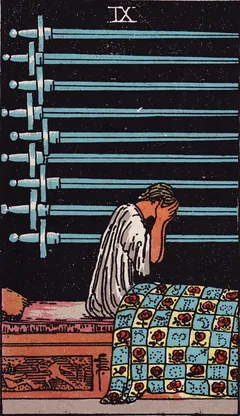
Restlessness and burnout are the two faces of the Four of Swords reversed. Either you can't switch off, or you pushed so long that your body is now forcing the break you skipped. Scrolling at 2 a.m. and answering emails on vacation turn rest into the sleepless bed of the Nine of Swords. A gentler reading is just as common. The rest is ending, and you are getting ready to return to work, to dating, to the world. Ask whether you are recovered or only impatient. Test yourself with one small task before you commit to a big one.
Four of Swords in love
Love takes a pause with the Four of Swords, a breather from dating or a quiet stretch inside a relationship. Single readers may still be recovering from the last relationship, and a few months off the apps is wise rather than lonely. Couples may need a truce after a run of arguments, with no heavy talks for a few days, more sleep and more small kindness. Space is not the same as distance. A pause you both agree on can save what another fight would break.
Reversed in love
The reversed Four of Swords in love signals that a break is ending, for better or worse. You may feel ready to date again, or an ex who went quiet may reach out. It can also mean restlessness that pulls you into a new romance before the last one has settled. Ask whether you're ready or just tired of waiting.
As feelings
The Four of Swords shows feelings that are real but on hold. The person is worn out by work, grief or an old conflict and needs room before they can give you more. Their silence is more likely tiredness than indifference.
Reversed as feelings
They're restless around you, done with waiting but not sure what they want yet. Some are close to burnout and may snap at small things that have little to do with you.
How they see you and what they will do
- How they see you
- From where they stand, you seem quiet, private and a little worn out, someone who needs space more than attention right now.
- What they will do
- Expect them to give you room rather than push. They may step back, wait or check in gently. A big move from them is unlikely until things calm down on both sides.
Work and money
In a career reading, the Four of Swords calls for a break, whether that's a vacation, sick leave, a sabbatical or simply a slower week. It often turns up after a big launch, a layoff scare or a long fight for a promotion, when you need to recover before choosing the next step. Use the quiet to plan, not to panic. With money, the card favors holding steady, with no big purchases, no risky bets and a calm look at the budget.
Reversed at work
Burnout at work is a common sign of the reversed Four of Swords, the point where skipped breaks start showing up as mistakes and short tempers. It can also mean coming back after leave or restarting a stalled project. Ease in with a shorter list than you think you can handle. With money, avoid big moves made out of restlessness.
Health and well-being
Rest and recovery are the health themes of the Four of Swords, from sleep and sick days to the slow return after an illness. Take the pause your body asks for and keep it simple: regular sleep, a lighter schedule, fewer screens at night. If exhaustion lasts or keeps coming back, a doctor can look for causes that rest alone won't fix.
Spiritual meaning
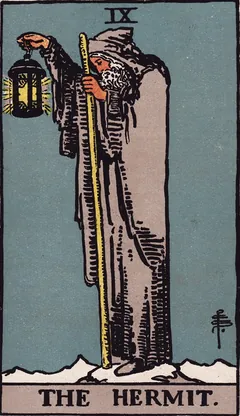
In spiritual terms, the Four of Swords teaches stillness, the practice of letting thoughts settle instead of fighting them. The knight lies with his hands raised in prayer, and the window above shows one figure reaching toward another who kneels. Prayer, meditation or ten silent minutes each morning all count. As with The Hermit, answers tend to come once the noise stops.
As advice
Book a real rest. Pick one evening or one full day this week, silence notifications and do nothing useful. If a decision is pressing, write it down and come back to it after you have slept on it twice.
Is the Four of Swords a yes or no card?
The upright Four of Swords gives a maybe that means not yet, because rest and a clear head have to come before action. Reversed, the answer stays maybe, since you are getting ready to move but are not fully recovered. Ask again after a pause.
Past, present and future
- Past
- A stretch of strain or conflict that left you needing more rest than you took.
- Present
- A pause to take seriously, with your phone down and big decisions on hold.
- Future
- Recovery first, and after it a clearer mind for whatever comes next.
Common combinations
- Three of Swords: rest after heartbreak, the quiet time a hurt heart needs before it can think straight.
- Knight of Swords: the urge to charge back in too early, so finish recovering before you act.
- The Star: real recovery, as rest slowly brings back hope, health and faith in what comes next.


What the card shows
A knight lies at full length on top of a tomb, eyes closed, hands pressed together in prayer and pointing up. He is painted the same pale gold as the tomb under him, which tells you he is a carved effigy, not a sleeping man. Three swords hang point down on the wall above. A fourth lies along the side of the tomb. In the corner, a stained-glass window shows a standing figure reaching toward a kneeling one in red. The fight, the scene says, is over for now.
- The knight in prayer: rest with intention, a mind turned toward peace instead of the fight.
- The gold effigy: stillness made solid, a figure carved in rest rather than asleep.
- Three swords on the wall: old conflicts and worries hung up and out of use for now.
- The sword along the tomb: one blade kept close, ready for when the rest is over.
- The stained-glass window: help, blessing or comfort that comes from outside the room.
What Waite wrote in 1911
“The effigy of a knight in the attitude of prayer, at full length upon his tomb.”
A. E. Waite, The Pictorial Key to the Tarot, 1911
Waite saw a funeral monument, not a nap. He listed “Vigilance, retreat, solitude, hermit's repose, exile, tomb and coffin” and admitted that “It is these last that have suggested the design”. His additional meanings open with “A bad card”. The real surprise is the reversal, which he read as money sense, “Wise administration, circumspection, economy”, with success after careful handling of affairs. Modern readers keep his retreat and solitude, set aside the coffin, and see a person at rest.
Astrology and numerology

Lord of Rest from Strife is the Golden Dawn title of the Four of Swords, a card the order gave to Jupiter in Libra. Jupiter brings relief and generosity, and Libra seeks balance and peace, so together they read as a truce granted after the fighting. The decan covers the last ten degrees of Libra, which the Sun passes from about October 13 to October 22. Four is the number of The Emperor, card IV, the builder of order. Here that order turns inward and settles the mind.
Questions people ask
Does the Four of Swords mean death?
No, the Four of Swords is read today as rest and recovery, not death. The figure is a carved effigy on a tomb, and Waite openly said that tombs and coffins inspired the picture. Modern readers keep the stillness and the retreat, not the funeral. In a health question it points to rest and recuperation.
How long does the Four of Swords last?
The Four of Swords has no fixed length, since tarot gives no set timing, and its rest lasts until you have truly recovered. After a hard week that may be a weekend, after a breakup or an illness it can be months. Signs it is ending include sleeping through the night and wanting to act again. Reversed, that point may be close, or you may be rushing back before it.
Why is the Four of Swords linked to Libra?
The Four of Swords is linked to Libra because the Golden Dawn assigned it to Jupiter in the sign's last ten degrees. The Sun crosses that decan from about October 13 to October 22. Libra is the sign of balance and peace, a natural home for a card about a truce after conflict.
Related cards