Five of Swords tarot card meaning

The Five of Swords is the fifth card in the suit of Swords, a smirking man gathering three swords while two beaten figures walk away toward the water. Upright, it means conflict, tension and winning at a cost. Reversed, it turns toward reconciliation, making amends and letting a fight go.
- Minor Arcanaan everyday card
- Suit of Swordsdecisions and conflict
- Element: Airthoughts and words
- Astrology: Venus in Aquariusthe planet and sign behind it
- Upright
- Conflict, winning at a cost, tension
- Reversed
- Reconciliation, making amends, letting go
- Yes or no
- No Yes when reversed
If you drew it today
Ask yourself whether this fight is worth what it costs. Today, peace might matter more than being right.
On this page
What the Five of Swords means
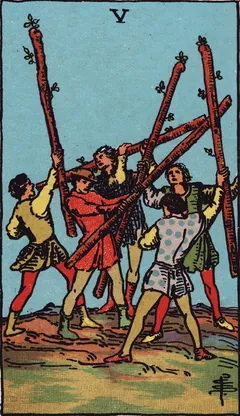
Winning at a cost is the core idea of the Five of Swords. Swords belong to Air, the suit of thoughts and words, so the battle here is usually an argument, a power struggle or a clash of pride. Where the Five of Wands is a noisy contest that everyone survives, this one has a winner and losers. The man keeps every sword on the field, yet nobody stays to share the moment. Before you count the score, ask which figure in the picture is you.
Upright meaning
The upright Five of Swords describes a conflict that someone wins at another person's expense. It might be the argument you won by bringing up an old mistake, the group chat where everyone took sides, or a colleague who got ahead by making you look slow. If you are the winner, ask what the win cost in trust. If you lost, walking away can be the smart move, not the weak one. Pick the one issue that truly matters and stop fighting the rest.
Five of Swords reversed

Reconciliation after a quarrel is how most modern readers interpret the Five of Swords reversed. The swords get put down. You may be ready to apologize, to accept an apology or to admit that being right stopped being worth it weeks ago. Sometimes it means leaving a fight you can't win, which is its own kind of peace. A darker version exists too, resentment that keeps flaring because nothing was really settled. Send one short message that names your part and adds no excuses.
Five of Swords in love
A fight where winning matters more than understanding is the Five of Swords in love. Couples may be keeping score, dragging up old mistakes or using silence as a weapon. Ask yourself whether you want to be right or stay close, because tonight you may not get both. For singles, it can describe dating that feels like a power game, or someone who needs the last word every time. Notice who leaves you feeling smaller after a conversation.
Reversed in love
A truce between partners is the usual meaning of the reversed Five of Swords in love. One of you may finally say sorry first, or you both stop rerunning the same old argument. For someone single, it can mean dropping resentment toward an ex so it stops shaping new dates. If the truce feels forced, talk about the real issue, not only the last fight.
As feelings
The Five of Swords signals resentment and wounded pride in how someone feels about you. They may still replay an argument, wanting the last word, or sense that they won the fight and lost you in the same moment.
Reversed as feelings
They want to make up. The pride that kept them quiet is softening, and they may send a careful message, admit their part or simply stop arguing to keep the peace.
How they see you and what they will do
- How they see you
- A rival, or the person who won an argument they still feel stung by, is how someone may see you under the Five of Swords. Some cast themselves as the winner and you as the one who walked away.
- What they will do
- Expect sharp words, a silent standoff or a move to get the upper hand. Some will leave rather than lose again. A calm, specific conversation works better with them than trying to win the next round.
Work and money
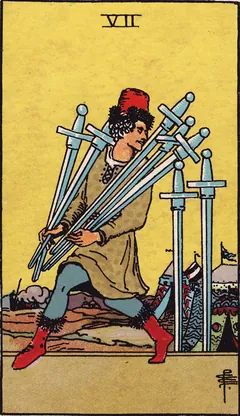
Office politics, credit grabbing and negotiations that turn hostile are the Five of Swords at work. You might win the promotion and lose the team, or get your way in a meeting while people quietly stop trusting you. Decide whether the battle is worth it before you enter it. With money, beware of deals where the other side wins by cutting corners, the territory of the Seven of Swords too. A dispute over shared money can drain more than it returns.
Reversed at work
The reversed Five of Swords at work signals a cooling conflict and a chance to rebuild trust with a colleague or a team. A rival may offer a compromise, or you may drop a dispute that was costing more than it was worth. With money, it favors settling a disagreement and splitting the difference rather than fighting for every dollar.
Health and well-being
Stress from conflict is the main well-being theme of the Five of Swords. Arguments replayed in the shower or at 2 a.m. keep the body on alert, with a tight jaw, shallow breath and poor sleep. Step away from the fight for an evening and talk it through with someone neutral. If tension or anger lingers for weeks, a doctor or counselor can help.
Spiritual meaning
Ego is the spiritual lesson of the Five of Swords. The man holds three swords, yet he stands alone under a torn sky. Winning against people you love is still a kind of losing. Ask what you are defending, your truth or your pride, and lay down whatever only protects the second.
As advice
Before you send the reply that wins the argument, read it once as the other person will. Delete every line that only scores a point, keep the one that says what you need, then send it or wait a day.
Is the Five of Swords a yes or no card?
Upright, the Five of Swords leans toward no, because the outcome would come through conflict or cost more than it brings. Reversed, it turns to yes, since the fight is ending and a fair agreement becomes possible.
Past, present and future
- Past
- An old argument you won or lost that still shapes how you fight today.
- Present
- A conflict where being right may cost you someone you care about.
- Future
- A chance to put the swords down and choose peace over the last word.
Common combinations
- Seven of Swords: a win that depends on deception, or on what the other side never found out.
- Justice: a dispute settled by rules or in court, where facts outweigh pride.
- Two of Cups: a quarrel between partners that can still end in a real apology and repair.


What the card shows
A red-haired man in a green tunic and red sleeves turns his head to watch two figures walk away from him. He holds two swords upright against his left shoulder, and his right hand rests on a third, its point toward the ground. Two more swords lie at his feet. One figure carries a red cloak over the shoulder, the smaller one stands at the water with head bowed. Torn clouds race across the sky. The fight is over, and only one person looks pleased.
- The smirking man: the winner who enjoys the victory more than the people around him.
- Three swords in his hands: everything gained from the fight, more than one person can use.
- Two swords on the ground: arguments given up, or weapons dropped by those who lost.
- The two figures walking away: the people who lost, or who chose to leave the fight.
- The torn clouds: a sky still unsettled after the conflict is over.
What Waite wrote in 1911
“He is the master in possession of the field”
A. E. Waite, The Pictorial Key to the Tarot, 1911
Waite saw nothing hopeful in this card. His upright list reads “Degradation, destruction, revocation, infamy, dishonour, loss”, and for the reversed card he wrote only “The same” plus “burial and obsequies”. His additional meanings call it “An attack on the fortune of the Querent” and, reversed, “A sign of sorrow and mourning”. Reading the reversal as reconciliation came later, from readers who see the swords finally laid down. Waite also never asked which figure you are, and that question is where modern readings begin.
Astrology and numerology

Venus in Aquarius stands behind the Five of Swords, a card the Golden Dawn named the Lord of Defeat. Venus wants harmony and closeness, while Aquarius prizes principles, ideas and independence. Together they describe a moment when being right on principle wins over warmth. The decan covers the first ten degrees of Aquarius, which the Sun crosses from about January 20 to January 29. Five links the card to The Hierophant, card V, the keeper of shared rules that a fight like this tends to break.
Questions people ask
Does the Five of Swords mean I should walk away from the fight?
Often yes, when the fight costs more than the issue is worth. In the Five of Swords, the two figures leaving the field look beaten, but they also stop losing. Before you go, name the one thing you still need and ask for it once, calmly. If staying only brings more insults or pressure, leaving is the healthier choice.
Am I the winner or the loser in the Five of Swords?
You could be either, and only an honest look at your recent behavior decides. If you pushed hard to get your way, you are probably the man holding the swords. If you backed down or felt humiliated, you are one of the figures walking away. Both roles teach the same thing about what the fight was worth.
What zodiac sign goes with the Five of Swords?
Aquarius. The Golden Dawn linked the card to Venus in the first ten degrees of Aquarius, a decan the Sun passes from about January 20 to January 29, and named it the Lord of Defeat. Venus seeks harmony and Aquarius holds to principle, so the card shows closeness losing out to being right.
Related cards