Ten of Swords tarot card meaning

The Ten of Swords is the last numbered card in the suit of Swords, a figure lying face down by still water with ten swords in its back. It means a painful ending, rock bottom and the release that comes once something is truly over. Reversed, it shows recovery, slow regeneration or resisting an ending that has already happened.
- Minor Arcanaan everyday card
- Suit of Swordsdecisions and conflict
- Element: Airthoughts and words
- Astrology: Sun in Geminithe planet and sign behind it
- Upright
- A painful ending, rock bottom, release
- Reversed
- Recovery, regeneration, resisting an ending
- Yes or no
- No Yes when reversed
If you drew it today
When something ends this hard, it really is over, and that is also a relief. Today, rest. The only way from here is up.
On this page
What the Ten of Swords means
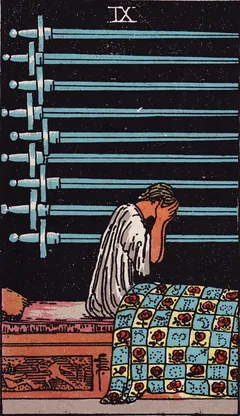
A complete ending, the kind that leaves nothing to rescue, is the core idea of the Ten of Swords. Ten closes the numbered cards of the suit, and Swords belong to Air, the element of thoughts and words. Notice the overkill, ten blades where one would do. That is how a mind handles a loss, replaying it until every sword is in. In the Nine of Swords, the blades float above a sleepless bed. Here each one has landed, so the bracing can finally stop.
Upright meaning
Something has ended for good when the Ten of Swords appears upright, and the ending hurts. A job you held on to is gone, a relationship has run out of second chances, or a plan collapses after months of warning signs. Sometimes the blow came from behind, through gossip or a friend's betrayal. Resist the urge to retell the story to yourself every hour. Write two short lists instead, what truly ended and what is still yours. The second list is usually longer than it feels tonight.
Ten of Swords reversed

Recovery is the first meaning of a reversed Ten of Swords, the slow work of getting up after an ending. Turn the picture upside down and the swords would slide out under their own weight. Sleep returns, the story gets shorter each time you tell it, and you start making small plans again. The second meaning is harder. You may be refusing an ending that has already happened, checking an ex's profile or reapplying to the job that let you go. Ask which one is you this week.
Ten of Swords in love
Between two people, the Ten of Swords in love marks a real end, not a pause. For singles, what ends may be the hope you kept for an ex, or the habit of rereading a thread that went quiet months ago. Let it close. For couples, the card can mark a betrayal or a breakup, but sometimes what dies is a pattern, the same fight on repeat. If you both want to stay, name the pattern that ended and agree on what replaces it.
Reversed in love
A reversed Ten of Swords in love marks recovery after a breakup or a betrayal, the first days when the ache is quieter. You may go a whole evening without checking their profile. The harder version is a finished relationship kept on life support with late-night texts. If you keep reopening it, write down what you expect to be different this time.
As feelings
Defeat and exhaustion sit behind the Ten of Swords as feelings. The person feels done, too tired to argue, and may believe things ended with one last blow, from you or from them. Give their silence room before reading it as an answer.
Reversed as feelings
Coming back to themselves is the reversed feeling. They are less defeated and may reach out more calmly, or they may still be clinging to a story that already ended between you.
How they see you and what they will do
- How they see you
- Through this card, they see you as someone who has taken a hard hit, perhaps one they caused. You may stand in their mind for an ending they are not proud of, or one they are relieved is over.
- What they will do
- A clean break is more likely than a slow fade. They may end things, block you or go silent for a long stretch. If contact returns at all, it comes after they have rested, so do not chase it in the first weeks.
Work and money
The Ten of Swords warns of a hard stop at work, such as a layoff, a canceled project or a role that ends after office politics turned against you. With money, it describes a loss you can no longer wait out, like a deal that fell through or savings running down faster than planned. Within the week, tell three people who know your work that you are looking. Then work out, in real numbers, how many months your savings cover.
Reversed at work
A career rebuilds slowly under the reversed Ten of Swords, usually after a layoff, a failed launch or a mistake everyone saw. You can tell the story of what happened in two calm sentences now. With money, debts may start to shrink. Waite read this reversal as gain that does not last, so save any windfall before you spend it.
Health and well-being
Exhaustion after a long strain is the usual health theme of the Ten of Swords. The figure lies flat, and your body may be asking for rest of its own, real sleep, regular meals and a day with no decisions. If the low mood does not lift after a few weeks, see a doctor or counselor. The card describes a low point, not a diagnosis.
Spiritual meaning
Surrender, the moment you stop arguing with a fact, is the spiritual lesson of the Ten of Swords. All ten swords are spent, and with them every argument the mind had left. What remains is quiet ground, still water and a strip of yellow light. Sit with what is true for a few minutes before you try to fix anything.
As advice
Say the ending out loud once, to a friend or to yourself, in a single plain sentence. Then do one small act that belongs to afterward, such as returning a key, archiving a chat or booking a haircut.
Is the Ten of Swords a yes or no card?
The Ten of Swords gives a clear no when upright, since the thing you are asking about has ended or is about to end. Reversed, it turns to yes, because recovery has begun and something new has room to grow, though not a return to what ended.
Past, present and future
- Past
- A collapse you lived through, still shaping what you expect to go wrong.
- Present
- Something is over now, and pretending otherwise only adds another sword.
- Future
- A final ending, followed by quieter mornings and the first plans of afterward.
Common combinations
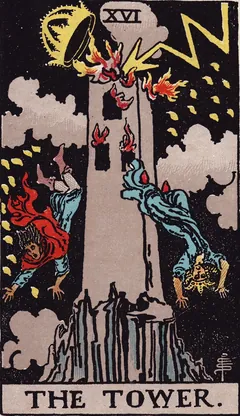
- Death: a chapter closing for good, the end of a way of life rather than a life.
- Seven of Swords: a stab in the back from someone you trusted, echoing Waite's note on treacherous friends.
- Ace of Swords: the suit ends and starts again, a clear new idea rising from the wreck of the old.


What the card shows
A figure lies face down at the edge of still water, a red cloth draped across him and spilling over the ground. Ten swords stand upright in him from the neck down, close as fence posts. One hand rests on the ground, fingers loosely bent, not clenched. Beyond the water runs a low line of pale blue hills. A black sky fills the top half, but a wide band of yellow light glows low above the hills. The blow is over, and the light is changing.
- Ten swords standing in the back: an ending finished to the last detail, with nothing left to fall.
- The red cloth: pain made visible, spreading farther than the wound itself.
- The band of yellow light: light gathering at the horizon while the sky above stays black.
- The still water: calm after a storm of thought, no wave left to fight.
- The loosely bent hand: the body letting go, with no fist left to clench.
- The face turned to the ground: someone who cannot see the light yet, though it is already there.
What Waite wrote in 1911
“It is not especially a card of violent death.”
A. E. Waite, The Pictorial Key to the Tarot, 1911
Waite kept his upright meanings close to the picture, “pain, affliction, tears, sadness, desolation”, and played down any link to violent death. The surprise is his reversal. Where modern readers see recovery, he listed “Advantage, profit, success, favour, but none of these are permanent”, a lucky turn with an expiration date. His additional meanings add “treason on the part of friends”, close to today's backstabbing reading, and for the reversed card, “Victory and consequent fortune for a soldier in war”.
Astrology and numerology

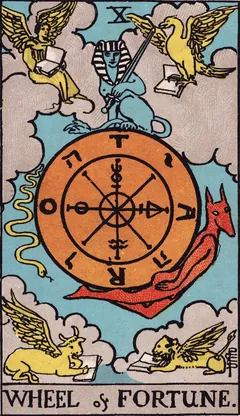
The Golden Dawn gave the Ten of Swords to the Sun in Gemini and named it the Lord of Ruin. Gemini is the sign of talk and second thoughts, and the Sun lights every corner of it. The result is a mind that sees every angle until it tires. The Sun crosses this last decan of Gemini from about June 11 to June 20, just before the June solstice, the longest day in the north. Ten ties it to Wheel of Fortune, card X, a turn rather than a stop.
Questions people ask
Does the Ten of Swords mean death?
No, the Ten of Swords describes the end of a situation, not the death of a person. Waite wrote that it is not especially a card of violent death. Like Death, card XIII, it is about endings in life, such as a job, a bond or a belief that has run its course. If a health fear brought you here, a doctor can answer what a card cannot.
Does the Ten of Swords mean betrayal by a friend?
Yes, the Ten of Swords is often read as a stab in the back, and Waite's additional meanings name treason on the part of friends. Check the nearby cards before you accuse anyone. Beside the Seven of Swords, someone may truly have acted behind your back. Alone, it can simply mean an ending that felt like an ambush.
Is the Ten of Swords connected to Gemini?
Yes, the Golden Dawn tied the Ten of Swords to the Sun in Gemini, the sign's last ten degrees, which the Sun crosses from about June 11 to June 20. Gemini is the twin-minded sign of words, so the ruin here tends to start in conversation and in the head. Birthdays in those days carry no curse, since a decan describes a card, not a person.
Related cards